Showing posts with label poverty. Show all posts

Solving the long-term housing crisis: Ambassadors to the Nations


My husband remembers a toddler boy running in and out of a tin make-shift shelter in Belize in 1996. He thought it was a tool shed, and asked another missionary if they should keep the boy out of the shed for fear of him getting hurt. The missionary replied that the shed was the boy's family home, pieces of corrugated metal tacked together with a tarp roof. The "house" was the size of a bathroom, about 6'x5', and 10 people slept there every night, on the bare ground.

I remember seeing these shacks - often with a chicken run attached to the side and a cow tied on a stake in the grassless front yard. Animal filth littered the yard in which children were playing happily on the hard packed dirt. The houses built by Samaritan's Purse were definitely an upgrade, with their solid foundation, rain-proof roof, and oven and stove in the kitchen. However, they were still approximately the same size. It was hard to imagine an entire family sleeping in this small space.


I recently learned of an organization that picks up where Samaritan's Purse leaves off, building sturdy, earthquake resistant homes measuring a relatively spacious 20'x20'. The houses have windows, doors, floors, electricity, running water, kitchen appliances, and furnishings, including beds that allow people to sleep in comfort and cleanliness. The houses cost just $4500 to build and $300 to furnish, with all donations going directly to the cost of building. Ambassadors to the Nations covers administrative costs through a separate donation process. They also run medical clinics, host short-term missionaries, and build and run schools and child sponsorship programs in Nicaragua, Mexico, Cuba, and Jamaica.

A fellow CCU nurse has taken on the work of raising money for a home in Nicaragua for a family of 12. To donate specifically to her house project, click on the link above, make your donation through Paypal, and type "Stabenow House" in the comments section.

Mission work orchestrated to solve both short-term and long-term needs is what the third world needs. By solving physical needs, missionaries are in a unique position to share the story of the greatest Giver our world has ever known.


When we dream, it's of the wind
Blowing cold and hard
When we wake up, we still live
in our house of cards
~House of Cards, Mary Chapin Carpenter~

Reflections on Samaritan's Purse: 12 Causes for Christmas

I've never seen Billy Graham speak, and I haven't met his son, Franklin. Yet I had the opportunity to work in concert with Samaritan's Purse to build homes, churches, and shelters while providing medical care to thousands of people in Central America in 2000-2002. Short-term missions teams were recruited by Samaritan's Purse to serve people affected by earthquakes, landslides and flooding in Honduras and El Salvador, countries facing thousands of deaths from natural disasters and the following political upheaval much like the current crisis in Haiti.

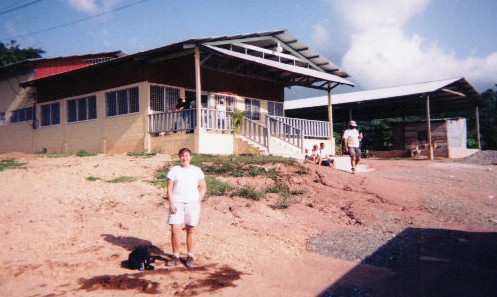
Church and shelter of building supplies in La Ceiba, Honduras
My job was to provide medical care, prescriptions, and medical devices to the suffering. We traveled by van to many remote locations, where construction team members erected cement block 10'x10' homes with tarp roofs. A location that broke my heart was Jerusalem, El Salvador, where we conducted our medical exams under a large tree unaffected by the recent earthquake, standing in the town square. I casted an open fracture on a 60 year old grandmother while other team members built a shelter for her, her cousin, grandchildren and great-grandchildren.


While I was wholeheartedly sold on the work being done by Samaritan's Purse, it never occurred to me that working with them might mean I could not work with other aid organizations based in the United States. Our ability to serve these people long-term ended with the construction of a sturdy medical clinic and church building on a location that very well might disintegrate during the next mudslide.


 Our team consisted of about 20 construction workers, and 10 or so medical personnel. As the need for triage grew in the first few days of the trip, I was forced to train two college students to take blood pressures, temperatures, and pulse. Our translators were teenage local girls.


Several patient's faces still haunt me to this day. A six-year-old boy was brought to the clinic across long suspension rope and plank bridges from the Guatemalan border. He was in gv, a type of seizure lasting more than 20 minutes. He had been seizing for ten hours when he hit the clinic doors, and continued to seize for 2 hours more while we frantically worked to save him. We placed a bite block - a sturdy stick brought in from the jungle. I ground up prescription anti-anxiety medication from one of the construction workers (she was afraid of flying on planes) and massaged the medication into his gums. He didn't stop seizing until I injected him with an anti-seizure medication. He stayed overnight on the clinic exam table and we found him stable and alert the next morning. His mother, grandmother and sister all accepted Christ that morning, and we sent them home with Keppra to prevent future seizures.


The number of children who visited our clinic gravely ill was staggering. One baby was too dehydrated to save, and died during the night while her mother tried to spoon Pedialyte into her cheeks.


On my second trip to Honduras, a mother and son visited the clinic. The baby's name was Jesús, and he was born in Jerusalem 4 weeks after we left in our bus. His mother traveled to La Ceiba when she heard that the Wisconsin mission team had returned. A year earlier, I had diagnosed her pregnancy - she was about 6 or 7 months along - and gave her prenatal vitamins. She was so grateful for giving birth to a healthy baby, she named him after the servant-King Jesus. This story touched my heart and validated the evangelical approach of Samaritan's Purse, which is to provide for the immediate medical and shelter needs of the people while sharing the Gospel with them.

One man visited our clinic in La Libertad, El Salvador. He was having an acute heart attack, with blood pressure 200/120, and heart rates in the 190s. He admitted he had been smoking some cocaine several times daily to keep him alert at his job - standing sentinel in a field of coca. Another field nearby grew marijauna for export to the United States. He humbly asked if he could smoke marijuana when he quit using cocaine, and we agreed that would be a better compromise given the state of his health. He showed us the fields, and I was in some form of North American shock at the volume of drug being grown. The men in the coca field were chewing the leaves. Many had symptoms of heart problems.

An excerpt from my missions journal tells a painful story:
God puts before us another poignant reminder of how temporary this all is. I have been called to serve his creations, watch over these physical bodies. Yet all I can do is labor with my hands, educate my mind, and pray. HE holds the keys to life and death. My guardianship over his people is so short-lived, so temporary. As we drove up into the mountains out to La Libertad, we came upon an accident. A small boy, twisted and broken, in a pool of dark blood, his bicycle nearby. It is hard to save people only for them to die. So hard to continue this ministry, which is so easily cut short. I have always wanted to save everyone - from pain, suffering, sorrow, anger, strife. I didn't come here expecting this much beauty, nor this much sorrow, nor as many lessons. Beauty has been the flash of white teeth from a dirty face, a lily tree growing from a pile of trash, the warmth of a hug from someone so ill they can hardly stand. Sorrow has been lacking the right ointment, a surgeon's skilled hands, a dead boy in the road shot clean through after we have just taken care of him and 200 others. Lessons have been sleeping on the floor amidst roaches, eating in a filthy town square, feeling the hand of God in every treatment decision, learning to change the things I can and accepting when I cannot. (July 13th, 2001)
Click to learn more about Samaritan's Purse, including their current medical mission work in Haiti and other impoverished nations. They also sponsor Operation Christmas Child and publish a unique catalog of gifts that can be bought for those living in poverty world-wide.


A promise of snow

Autumn whirls by like a flutter of leaves emancipated from the backyard by a rake, lifted and swirling in one iridescent moment of final glory, and then gone forever into the black plastic of a lawn bag. Long night shifts caring for sick strangers, hockey practice, first flurries of snow. The week hurtles on and I don't pause to write or hardly to think. The incomparable adrenaline laced rush of joy after physical accomplishment washes over me and drowns me in happiness after hockey practice. Nine years of having babies, and I can still stop a puck and have fun out on the ice with a group of women. 


My friend from afar is in Ecuador, meeting children helped through the Compassion International program. It is a hard thing to have a missionary's heart and not bend to the constant plea of so many people. But in uncertain times, when we are making budget cuts $10 at a time, that $38 a month seems like a large commitment, especially when so important and a must every month for that one family. All kinds of things fly through my mind, my doctoral degree, so expensive - really necessary? Well, yes, if we're going to go to Central America and start a nursing school. The winter boots for kids - should I have looked longer at thrift stores in search of cheaper options? Well, no, not when the snow is already falling. What about hockey? How much money do you spend just to rediscover an old joy?


It's hard to be the bud holding promise of next spring, a handful of snowflakes to water the earth when the frozen times are done. Yet this is what young families often do, hold the snowflakes to point to the thaw. We are still growing and learning, learning this one income life, learning what it takes to be a missionary, stem frozen in time by cancer and encephalitis. We can't go yet. We will go one day, to the vast reaping fields. The fields holding the promise for the spring yet to come. They will still be there when we are ready...for the poor you'll always have with you. Perhaps that is one of God's great and incomprehensible gifts: a world where we stay in touch with our poverty. For without a visual picture of poverty, if every man were rich, would we really keep needing God? Not until the grave's doorstep, when we finally realize we can't take it with us. Money is just a dusting of snow on frozen ground...the promise of food for this life while we wait for the next. Autumn holding spring's thaw.

Linked up to Joy's life: unmasked writing project

To have and have not


As you walk into the flood of work that is mothering, you feel your self rusting from misuse. Depression has forced my hand, made me pick up some of those pieces of self I have sacrificed for years. One night a week, I am alone with friends, singing. I play piano more these days, and have reclaimed some of my artistic talent with charcoals and paints and canvases. But I still can't remember the last time I used the bathroom without getting interrupted with some petty complaint or question from my children. This rubs a spot raw on my soul, and I look at it and then suddenly remember.


I've used bathrooms like this, where you certainly don't care to linger. You'd be happy to have company so you wouldn't be the only one swatting off bugs, flies, spiders and geckos. Some people would be lucky to have even this luxury of a pit toilet and standing shower.


I feel like the rug on the floor some days - dirty, walked upon, and used up. But the truth is, I don't live in a dirt floor house in which I build a fire to cook meals of plantains and banana water for my starving children.


Yes, my body has gotten shabbier and shows the wear of years of childbearing and nursing. My paint is peeling around the edges and I sag where I shouldn't and I struggle to find comfortable blue jeans.


But rust isn't bubbling up on me like some kind of disease. I am not pink with bacteria or stubby with oxidization. There is beauty even in those parts I see as ugly since childbirth. My husband sees it. I am learning to have eyes that see it.

Traveling with kids is kind of like trying to go to the bathroom myself.  They are constantly pestering in our oldish minivan. Did I forget that air conditioning, a roof on a car, seatbelts are all luxuries that over 2/3 of the world can't even dream of possessing? Am I really complaining about being confined in this car with these kids when I've ridden in minibuses with the windows sealed shut to keep guerrilla warriors out should we meet them as we travel to the jungle where there are piles of rotting bodies from the latest mudslide?


Global perspective gained from the mission trips I traveled on prior to my marriage constantly reminds me of how good I live life. It staunches the complaining spirit and demands the sacrifice of praise.

Next time you are feeling like you can't do it anymore - browse the globe through Google and be astonished. I guarantee your complaint will quickly turn to counting your blessings.